Overall SDG Alignment Evaluation:
The Master of Science Program in Mathematics is designed to produce researchers with deep theoretical knowledge and the ability to create new mathematical knowledge that is internationally recognized. The curriculum's rigorous focus on advanced mathematics and research provides the fundamental language and tools for technological and scientific innovation, making it a critical enabler for SDG 9 (Industry, Innovation, and Infrastructure). By training a new generation of mathematicians and educators, the program is a flagship for SDG 4 (Quality Education), ensuring the high-level skills necessary for a knowledge-based society. Furthermore, the program's international scope and its emphasis on collaborative, globally relevant research foster the partnerships essential for SDG 17 (Partnerships for the Goals).
Best Practices
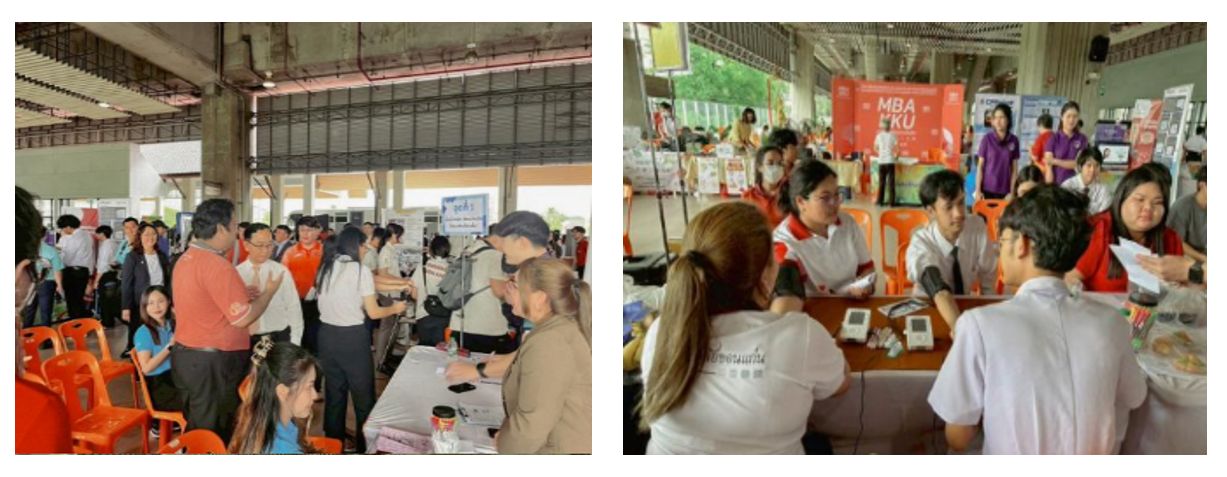
The Master of Science Program in Mathematics of Khon Kaen University (KKU) has driven strategic social responsibility by engaging as a part of the solution to the problem of access to comprehensive public services, recognizing the necessity to elevate the quality of life and well-being of urban and human settlements sustainably. The activity that was integrated into the curriculum was the participation as the main working committee (Subcommittee of the Graduate Student Club) in managing the "Khon Kaen University Societal Contribution Fair." This operation involved integrating leadership and academic service roles with the cultivation of system analysis and presentation skills acquired from the course SC 467 891 Seminar in Mathematics and large-scale project management skills related to research under the course SC 467 898 Thesis (or SC 467 899 Independent Study for Plan B). The event effectively translated mathematical knowledge into practical application for organizing a proactive, integrated health service activity, provided free of charge via 50 booths to the public across 95 communities within Khon Kaen Municipality and nearby areas.
The evident result is the effective expansion of access to basic public health services among the wider population and the strengthening of a robust relationship and trust between the university and the urban community. The sustainable impact involves elevating the overall quality of life and well-being of human settlements in the urban area, making them socially robust and safe, which serves as the foundation for truly sustainable urban development.
This activity is therefore deeply aligned with SDG 3: Good Health and Well-being, which promotes good health and universal access to health services; SDG 11: Sustainable Cities and Communities, which aims to make cities inclusive, safe, and resilient with accessible public services; and SDG 17: Partnerships for the Goals, which focuses on forging a powerful cooperation network between the academic institution, the community, and partner agencies to drive shared goals.
 SDG 4: Quality Education
Alignment Summary: As a master's program, this curriculum represents a high level of quality education. It is designed to cultivate expert researchers and academics by providing advanced training in mathematical research and fostering a culture of lifelong learning, thereby contributing to the creation of new knowledge for sustainable development.
| Course Code | Course Title | Alignment Rationale |
|---|---|---|
| SC 129 891 | Seminar in Mathematics 1 | Enhances lifelong learning opportunities (Target 4.3) by providing a platform for critical analysis and discussion of current research, fostering the skills to create new knowledge. |
| SC 129 898 / 899 | Thesis / Independent Study | These courses are capstone lifelong learning opportunities (Target 4.3), where students conduct original research or in-depth study, acquiring superior skills for employment and innovation (Target 4.4). |
 SDG 9: Industry, Innovation and Infrastructure
Alignment Summary: The curriculum drives innovation by providing the fundamental mathematical tools required for advancements in science, technology, and engineering. The deep theoretical knowledge in areas such as algebra, analysis, and applied mathematics enhances the scientific research and technological capabilities of a wide range of industries.
| Course Code | Course Title | Alignment Rationale |
|---|---|---|
| SC 127 701 | Algebra | Provides foundational knowledge that is essential for innovation in computer science, cryptography, and data science, thereby supporting scientific research (Target 9.5). |
| SC 127 702 | Real Analysis | This core mathematical discipline is fundamental to developing the models and algorithms that drive innovation in engineering, finance, and technology (Target 9.5). |
| SC 127 705 | Applied Mathematics | Directly supports industrial innovation by training experts to apply mathematical models to solve real-world problems in engineering and science (Target 9.5). |
 SDG 17: Partnerships for the Goals
Alignment Summary: The program's international scope and research-intensive nature foster partnerships for sustainable development. Through seminars and the research process, students engage with the global mathematical community, promoting the knowledge-sharing and collaborations needed to achieve global scientific and technological goals.
| Course Code | Course Title | Alignment Rationale |
|---|---|---|
| SC 129 891 | Seminar in Mathematics 1 | Promotes the global partnership for sustainable development (Target 17.6) by requiring students to engage with and present on international research, fostering a culture of global knowledge-sharing. |
| SC 129 898 / 899 | Thesis / Independent Study | Represents a significant contribution to global partnerships (Target 17.16) by creating new, publishable knowledge that is shared internationally to solve critical challenges in science and technology. |